The Papenoo Valley by 4WD: One Track Into Tahiti's Interior, an 800-Metre Tunnel, and Why the Guides Exist
Updated September 25, 2026 · 7 min read
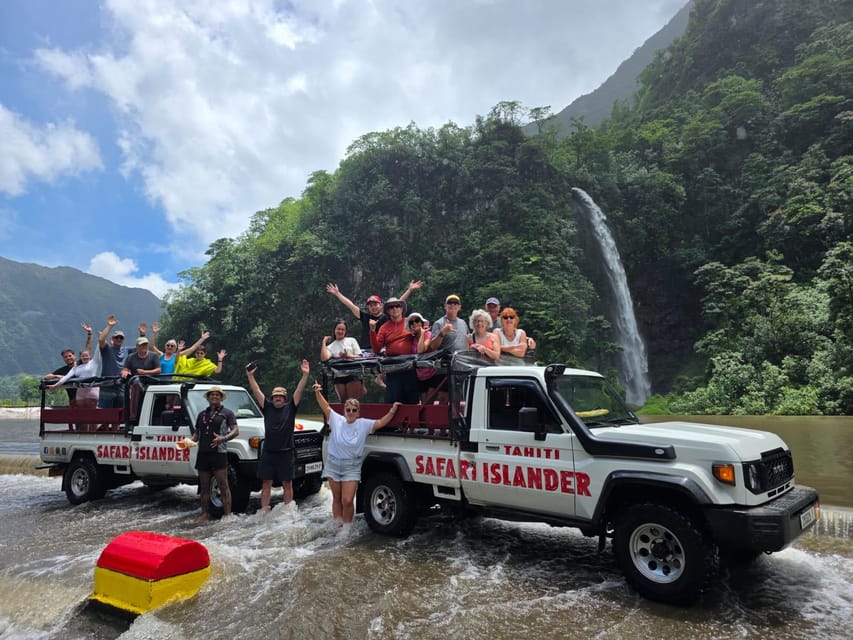
Almost everything on Tahiti happens on a thin ring of flat land between the sea and the mountains. The road follows it, the villages sit on it, and the interior — a collapsed volcano full of rivers, ridges and rain — has no road at all.
With one exception. At Papenoo, on the north coast, a track turns inland and keeps going.
The valley has a road because it has dams
The Papenoo track is not a scenic route that someone built for visitors. It is an access road for the hydroelectric scheme that was driven into the valley in the 1980s, and everything a tour shows you today sits alongside that infrastructure.
The most striking piece of it is the tunnel. Tahiti Heritage describes it plainly: a tunnel 800 metres long, in the middle of nowhere, cut during the construction of the Papenoo dams at the end of the 1980s by the company Marama Nui. It goes under the rim of the old crater and comes out on the side of the island that drains south.
The Relais de la Maroto, the building most day trips stop at or pass, began the same way — it opened in 1986 as quarters for the people building the network, and only later became somewhere to stay.
That origin is worth knowing before you go, because it explains the surface you will be riding on. This is a works road through a wet valley, not a mountain pass.
What the seven-hour trip actually does with the day
The only way in our inventory carries is the Tahiti Safari Islander 4×4 day trip to Papenoo and Maroto: €132, 4.9 stars from 63 reviews, seven hours.
The operator publishes its own timings, and they are more useful than any description:
- around 8.00 to 8.30 am — pick-up from hotels between Punaauia and Arue, by name and by hotel
- about 8.40 am — a stop at the bakery, before the valley
- about 9.20 am — the start of the Papenoo valley
- 11.30 am — picnic and swim break
- 12.30 pm — onward through the caldera and the volcano to Lake Vaihiria
- 3.00 pm — out of the valley
- 3.30 pm — back at the hotel
Two things follow from that list. The first is that it is an out-and-back through the middle of the island rather than a crossing that drops you somewhere else. The second is that the bakery stop is not a courtesy — it is where your lunch comes from.
The bakery stop is the meal
Meals and drinks are not included. The listing says so, and then says what to do about it: the vehicle stops at the bakery before entering the valley, and you should allow around €10 per person.
That is an honest way to run a long day in a place with nothing to buy, but it catches people who assume a seven-hour tour feeds them. If you are travelling with children who will not eat a French bakery lunch, this is the stop where that gets solved, and there is no second chance further in.
What the price does cover: the pick-up, the 4×4 itself, a driver-guide, a sound system the guides use for Polynesian stories and music, and a tasting of local fruit depending on the season.
If you are arriving by ship rather than staying in a hotel, the operator picks cruise passengers up at the pharmacy in the harbour — a detail that is easy to miss and impossible to guess.
Who the operator turns away
The listing carries a long list of conditions, and it is worth reading properly rather than at a glance: pregnant women, people with back problems, wheelchair users, people with recent surgery and people prone to motion sickness are all named as unsuited to this trip.
Age limits appear too, but they appear several times over with different numbers — under two and under three at the young end, and over 70, 75, 80 and 95 at the other. That pattern means the limits belong to the individual booking options rather than to the tour as a whole. Check the condition on the option you are actually booking, and ask if it matters to your party.
The back-problem warning is the one to take at face value. A works road in a river valley is rough by design, and the vehicles are open-backed.
Could you drive it yourself?
You can rent a four-wheel drive on Tahiti, and the track is not closed to private vehicles. Whether that is a good idea is a different question, and the local advice is consistent: sections of the route are hazardous, the risk of rockfall means stopping is not allowed in places, and a guide is the sensible choice.
There is also the practical point that the interest of the valley is not the driving. Which ridge you are looking at, which dam you have just crossed, why a stone platform sits in that particular clearing — none of that is legible from the driver’s seat of a hire car.
Very few tours, a great deal of weight
Our 4x4 and quad tours listings hold 8 offers from €55, with a median of €113.88 — and those eight carry 565 reviews between them. The waterfalls and hiking page is similar in shape: 11 offers from €55, 526 reviews.
Small categories, heavily booked. On an island where most of the inventory is boats, that says something about what people do with a day ashore once they have seen the lagoon.
For the version of this that stays on the coast road, with the waterfalls and the grottoes you can reach in a normal car, see driving around Tahiti Nui. The same idea on the other island is in Moorea by 4WD — a shorter, gentler day, and a different kind of landscape.
Prices, ratings, review counts and the published timings above were read on 25 September 2026. Pick-up times shift with where you are staying, and a valley road with a rockfall warning on it is a road whose condition is decided on the day — by the operator, not by the booking page.